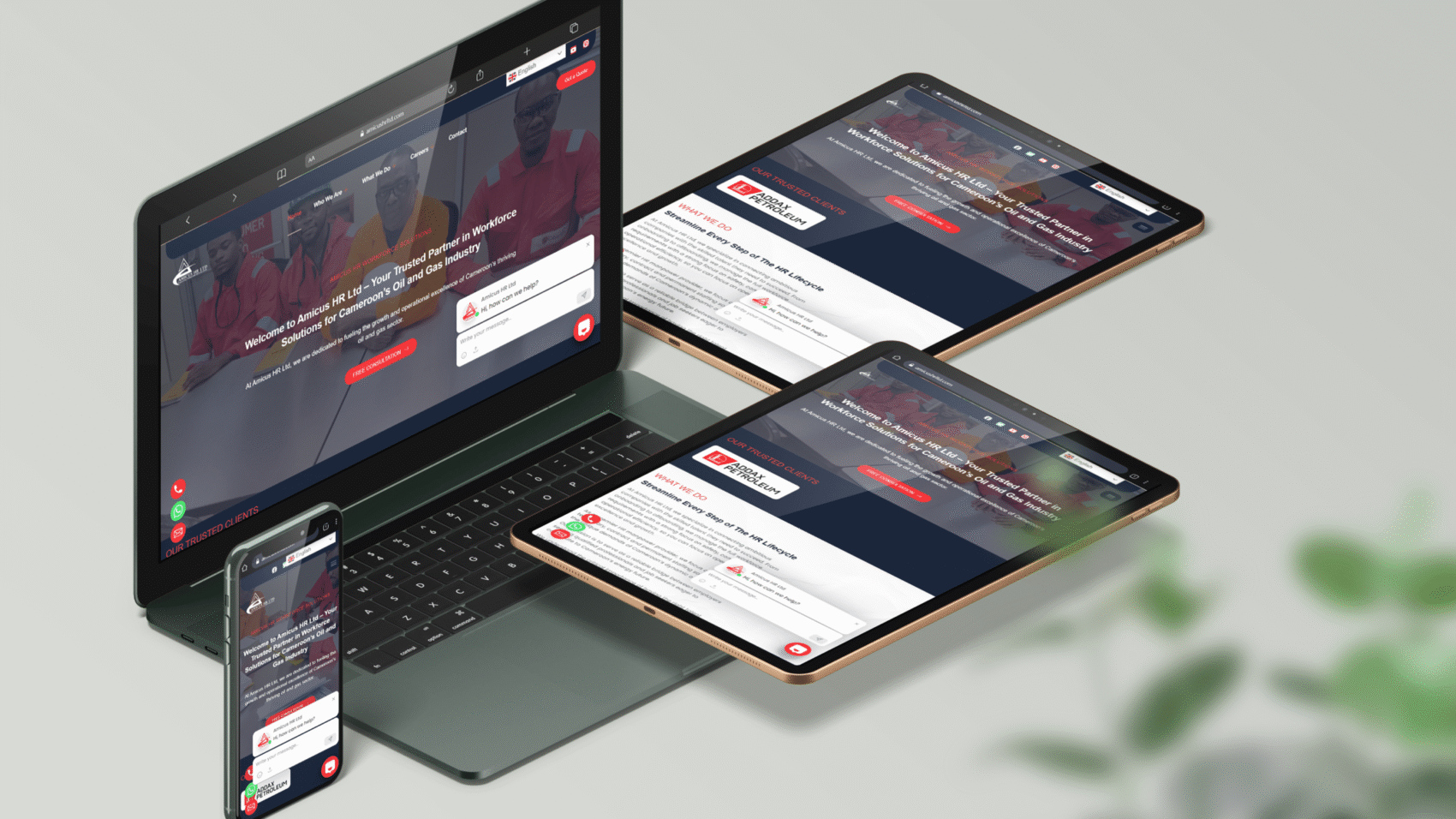
At Amicus HR Ltd, we are dedicated to fueling the growth and operational excellence of Cameroon’s thriving oil and gas sector.

Website Redesign Checklist for Small Businesses in Cameroon: What to Fix Before You Rebuild

Website Redesign Checklist for Small Businesses in Cameroon: The Short Answer

A website redesign checklist for Cameroon small businesses should cover six core areas before you spend a single franc on rebuilding: performance and mobile speed, SEO and content audit, user experience and navigation, branding consistency, technical health, and realistic budget planning.

Skipping this audit is the most common reason redesigns in Cameroon fail to improve results, businesses pay to rebuild without fixing the underlying problems that made the old site underperform in the first place.

This guide walks you through every step in plain language, whether you are based in Buea, Douala, Yaoundé, or anywhere else in Cameroon.

When to Redesign a Business Website: Signs You Cannot Ignore

Before opening your wallet, confirm that a redesign is actually what your business needs. Many small businesses in Cameroon confuse a slow site with a site that needs a full rebuild. Sometimes the fix is cheaper and faster than a complete overhaul. That said, there are clear signals that a redesign is overdue.

  • Your site loads slowly on mobile data. The majority of internet users in Cameroon browse on mobile networks like MTN and Orange. If your pages take more than three seconds to load, you are losing customers before they even see your offer. Read more about this in our guide on how to make a website load faster on mobile data in Cameroon.
  • Your site is not bringing in any leads or enquiries. A website that looks fine but generates zero WhatsApp messages, calls, or form submissions is not doing its job.
  • The design looks outdated or unprofessional. Visitors judge a business within seconds of landing on its site. An outdated design communicates that your business may not be active or trustworthy.
  • Your site is not mobile-friendly. If users have to pinch and zoom to read your content, your site was likely built before 2016 and needs a full rebuild.
  • You cannot update it yourself. If adding a new service or changing your phone number requires calling a developer every time, your site was built on the wrong foundation.
  • Your competitors have overtaken you online. If a search for your service in Douala or Buea returns competitor sites before yours, that is a structural and SEO problem a redesign can solve.

Understanding why every small business in Cameroon needs a website in 2026 also helps frame what your new site must actually accomplish, not just look good, but convert visitors into paying customers.

The Full Website Redesign Planning Checklist

Work through this checklist section by section before briefing any designer or agency. Completing it first saves time, reduces back-and-forth, and protects your budget.

1. Audit Your Current Website Performance

Start by understanding what your existing site is actually doing wrong. Many problems are invisible until you measure them.

  • Test your site speed on a mobile connection using Google PageSpeed Insights or GTmetrix. Note your score for mobile separately from desktop.
  • Check which pages get the most traffic in Google Analytics or Google Search Console. Do not delete or restructure high-traffic pages carelessly.
  • Identify your current bounce rate. A very high bounce rate on mobile usually points to speed or layout issues.
  • Test your site on at least two Android phones — the type most Cameroonian customers actually use.

Our detailed guide on website speed on mobile data in Cameroon explains exactly which technical fixes make the biggest difference for local users.

2. Audit Your Existing Content

Content is often overlooked during redesign planning, but it is one of the most important assets your new site will carry forward.

  • List every page on your current site. Decide whether each page should be kept, updated, merged, or deleted.
  • Check whether your service pages clearly explain what you offer, to whom, in which city, and at what price range.
  • Confirm that your contact details, phone number, WhatsApp link, location, and email, are visible and correct.
  • Identify any pages that rank in Google, even weakly. Preserve those URLs during the redesign to avoid losing search rankings.

If your business operates in both English and French, your content structure needs specific planning. Our guide on bilingual website SEO in Cameroon covers how to structure English and French pages correctly without hurting your rankings.

3. Review Your SEO Foundation

A redesign that ignores SEO can cause your Google rankings to drop immediately after launch. This is one of the most costly mistakes small businesses in Cameroon make when rebuilding their sites.

  • Document all existing URLs that receive organic traffic before the redesign begins.
  • Set up 301 redirects for any URLs that will change after the rebuild.
  • Make sure every page on the new site will have a unique title tag and meta description.
  • Plan for local SEO: your new site should mention your city, neighbourhood, or region naturally in the content. See our local SEO tips for small businesses for a practical starting framework.
  • Confirm your Google Business Profile is set up and linked to your new site. If you have not done this yet, follow our guide on setting up a Google Business Profile for a business in Cameroon.

4. Define Your Goals and User Journey

This is the step most small businesses skip entirely. Before a designer draws a single wireframe, you must know what you want the new site to do.

  • What is the single most important action you want visitors to take? (Call you, send a WhatsApp message, fill a form, visit your shop?)
  • Who is your primary visitor, a first-time customer, a returning client, or a business partner?
  • What questions does a typical customer have before they buy from you? Your new site should answer those questions clearly and early.
  • Map out the journey from homepage to conversion. Every page should move the visitor one step closer to that action.

5. Gather Your Brand Assets

One of the most common causes of redesign delays in Cameroon is businesses arriving at their first design meeting without basic brand materials. Prepare the following before you start:

  • Your logo in vector format (SVG or AI file) or high-resolution PNG with a transparent background.
  • Your brand colours as hex codes, if you have them.
  • Professional photos of your products, team, or premises. Stock photos can supplement but should not replace real images of your business.
  • Testimonials or reviews from past clients, with their permission to publish.

6. Plan Your Budget Realistically

Website redesign cost in Cameroon varies significantly depending on the size of the site, the features required, and the agency or freelancer you choose. Understanding the full cost before committing prevents unpleasant surprises.

Our comprehensive breakdown of website costs in Cameroon for 2026 gives you specific price ranges for different types of sites so you can budget accurately. Once your new site is live, you will also want to understand the ongoing website maintenance costs in Cameroon, hosting, updates, security, and content changes are recurring expenses that need to be factored into your plan from day one.

As a general guide, ask your chosen agency or developer these questions before signing anything:

  • Is mobile-first design included by default, or is it an extra?
  • Will the site be built on a CMS like WordPress that I can update myself?
  • Who owns the domain and hosting after the project ends?
  • Is SEO setup, title tags, meta descriptions, sitemap, Google Search Console, included in the price?
  • What happens if something breaks after launch?

What to Hand Over to Your Designer or Agency

Once you have completed the checklist above, you are ready to brief a professional. A good brief shortens the project timeline and reduces the risk of misunderstandings. Your brief should include a clear description of your business and target audience, a list of pages required, your logo and brand assets, any websites you admire and why, your primary goal for the new site, and your confirmed budget and timeline.

G-DESIGNS LTD offers web design services built specifically for Cameroonian businesses, mobile-first, SEO-ready, and designed to generate real enquiries rather than just look good. If you have worked through this checklist and are ready to move forward, contact us to discuss your project.

Summary: Your Website Redesign Checklist for Cameroon

To recap, here are the six areas you must review before rebuilding your business website in Cameroon:

  1. Performance audit: Test speed on mobile data, identify slow pages.
  2. Content audit: Decide what to keep, update, or cut.
  3. SEO review: Protect existing rankings, plan redirects, prepare for local search.
  4. Goal and user journey definition: Know what the site must achieve before design begins.
  5. Brand asset preparation: Logo, colours, photography, and testimonials ready before briefing.
  6. Budget planning: Account for build cost, hosting, maintenance, and ongoing updates.

A redesign done without this groundwork is a redesign likely to disappoint. Do the audit first, brief clearly, and you will end up with a website that works as hard as your business does.

Further Reading

Google’s guide to site moves and URL changes

W3C’s Web Content Accessibility Guidelines overview

Google PageSpeed Insights overview

Bilingual Website SEO in Cameroon: How to Structure English and French Pages

Bilingual Website SEO in Cameroon: What You Need to Know First

Cameroon is officially bilingual — English and French are both national languages, spoken across every major city from Buea and Limbe to Douala and Yaoundé. For any business operating here, that bilingual reality is not just a cultural fact — it is an SEO opportunity and a technical challenge at the same time. If your website serves customers in both languages but is not structured correctly for search engines, you are likely losing significant organic traffic to competitors who have figured this out.

This guide explains exactly how to structure English and French pages for bilingual website SEO in Cameroon — covering URL architecture, hreflang tags, on-page optimisation, and local search signals that Google actually uses to rank bilingual sites. Whether you run a construction firm in Douala, a communications agency in Yaoundé, or a training centre in Buea, this applies directly to your website.

If you are new to SEO fundamentals, start with The Ultimate Guide to Understanding SEO before diving into the bilingual-specific details below.

Why Bilingual SEO Is Different from Simply Translating Your Website

Many businesses in Cameroon make the same mistake: they build a website in English, then add a French translated version — sometimes just using Google Translate — without any proper technical structure. The result is that Google either ignores the French pages entirely, treats them as duplicate content, or fails to show the right language version to the right user.

Bilingual SEO is not about translation. It is about telling search engines clearly and unambiguously that you have two separate, intentional versions of your content — one for English-speaking users and one for French-speaking users — and ensuring each version is fully optimised in its own language and indexed independently.

Done correctly, bilingual website SEO in Cameroon can effectively double your search engine surface area, since you appear in results for both English and French queries on the same topics.

Step 1: Choose the Right URL Structure for English and French Pages

The URL structure you choose is the foundation of your bilingual SEO architecture. There are three common approaches, and each has trade-offs for businesses in Cameroon:

  • Subdirectories (recommended): yoursite.com/en/ and yoursite.com/fr/ — This keeps all SEO authority on one root domain while clearly separating language versions. This is the most practical approach for small to mid-size Cameroonian businesses.
  • Subdomains: en.yoursite.com and fr.yoursite.com — Technically workable, but Google treats subdomains as separate entities, which can dilute your domain authority, especially for newer sites.
  • Separate domains: yoursite-en.com and yoursite-fr.com — Almost never advisable for businesses in Cameroon. You split your authority, double your maintenance cost, and confuse your audience.

Best practice for Cameroon: Use subdirectories. Structure your English content under /en/ and your French content under /fr/. Your homepage can auto-detect the browser language and present the appropriate default, but always allow manual switching.

Step 2: Implement Hreflang Tags Correctly on Every Page

Hreflang tags are the most important technical element in any bilingual SEO setup. They tell Google which language version of a page exists for which audience — and they prevent your English and French pages from competing against each other in search results.

For a bilingual website in Cameroon targeting both English and French users, your hreflang implementation in the <head> section of every page should look like this:

<link rel='alternate' hreflang='en' href='https://yoursite.com/en/your-page/' />
<link rel='alternate' hreflang='fr' href='https://yoursite.com/fr/votre-page/' />
<link rel='alternate' hreflang='x-default' href='https://yoursite.com/' />

Key rules for hreflang on French English websites targeting Cameroon:

  • Every page must reference both language versions — including itself. If your French page does not reference the English version and vice versa, the tags are broken.
  • The x-default tag points to your default or language-neutral homepage and is required.
  • Hreflang tags can also be implemented via XML sitemap if you have a large site — this is often cleaner for WordPress-based websites.
  • Use hreflang='en' and hreflang='fr' rather than country-specific variants like en-CM or fr-CM unless you are targeting specific national audiences exclusively. For Cameroon, broad language codes usually perform better.

Step 3: Write Genuine, Original Content in Both Languages

Google’s algorithms in 2025 are highly effective at detecting auto-translated or thin content. For bilingual website SEO in Cameroon to work properly, each language version must be written — or at minimum professionally edited — in that language, with natural phrasing, local context, and original keyword research done separately for each language.

This means your English SEO keywords and your French SEO keywords will often be different. A Buea-based law firm, for example, might target “business lawyer Buea” in English and “avocat d’affaires Buea” or “cabinet juridique Douala” in French — these are entirely different search queries with different competition levels and search volumes.

Practical content checklist for each language version:

  • Conduct separate keyword research for English and French target audiences
  • Write unique meta titles and meta descriptions for each language page
  • Use language-appropriate heading structures (H1, H2, H3) with localised keywords
  • Include culturally relevant examples, place names, and local references in each language
  • Ensure image alt text is also translated and keyword-optimised per language

Step 4: Configure Google Business Profile for Bilingual Visibility

Your website is only one part of bilingual local SEO in Cameroon. Your Google Business Profile (GBP) is equally important — especially for searches like “meilleure agence web à Douala” or “web design company in Buea.” Google Business Profile allows you to set a business description in multiple languages, and responding to reviews in both English and French signals bilingual credibility to both users and search engines.

See our complete walkthrough on how to set up a Google Business Profile for a business in Cameroon to make sure your local listing supports your bilingual SEO strategy.

Step 5: Build Language-Specific Internal Linking Structures

Internal links within your website should stay within the same language version. Your English blog posts should link to other English pages. Your French pages should link to other French pages. Cross-language internal links can confuse both users and crawlers, and they weaken the topical coherence of each language section.

Internal linking also distributes page authority across your site — a critical factor in how Google ranks individual pages. To understand why this matters structurally, read our guide on the importance of backlinks in SEO and how to build them. The same logic applies internally: link authority flows through your site architecture.

Step 6: Optimise Technical SEO for Both Language Versions

Beyond hreflang and URL structure, several technical factors affect how well both versions of your site rank:

  • XML Sitemaps: Submit a sitemap that includes all pages in both languages, with hreflang annotations. Some WordPress SEO plugins like Rank Math or Yoast SEO handle this automatically when configured correctly.
  • Canonical Tags: Each page should have a self-referencing canonical tag to prevent any internal duplication signals.
  • Page Speed: Both language versions must load quickly — aim for under 3 seconds on mobile. This is especially important in Cameroon where mobile data speeds can be inconsistent.
  • Mobile Responsiveness: The vast majority of web users in Cameroon access sites via mobile. Both English and French versions must be fully responsive.
  • Schema Markup: Use LocalBusiness schema with language-specific content where appropriate to support AEO and GEO visibility — helping AI assistants and answer engines cite your business correctly.

Voice search is also a growing consideration for bilingual markets. Read our guide on how to optimise your website for voice search to ensure your bilingual content is positioned for conversational queries in both languages.

Common Bilingual SEO Mistakes Cameroonian Businesses Make

To save you time and avoidable penalties, here are the most frequent errors we see when auditing bilingual websites for businesses in Buea, Douala, and Yaoundé:

  • Using machine translation without human review — creates unnatural language patterns Google now easily detects
  • Implementing hreflang tags on only one language version instead of both
  • Using the same meta title and description for both language pages (duplicate meta content)
  • Forgetting to include the language switcher in a visible, accessible location for users
  • Blocking the French or English version of the site in robots.txt accidentally during development and never reversing it
  • Pointing both language versions to the same canonical URL, effectively telling Google only one version exists

Does Your Business in Cameroon Need a Bilingual Website?

Not every business needs a full bilingual SEO strategy from day one. If your clients are exclusively Anglophone (common for businesses based strictly in Buea, Limbe, or Bamenda), starting with a strong English SEO foundation is the right priority. If you serve Douala or Yaoundé — both of which are highly French-dominant markets — a French-first or bilingual approach becomes critical quickly.

Before investing in a bilingual structure, ensure you have the basics covered: a professional, fast, mobile-friendly website. If you are still weighing that decision, read why every small business in Cameroon needs a website in 2026 for the full case.

Get Expert Bilingual SEO Help in Cameroon

Structuring a bilingual website for SEO is a technical undertaking that requires getting multiple interdependent elements right simultaneously — URL architecture, hreflang tags, original content in both languages, internal linking, and schema markup. One misconfiguration can cause Google to ignore an entire language version of your site.

G-DESIGNS LTD is one of the leading SEO companies in Cameroon, based in Buea and serving clients across Douala, Yaoundé, and the wider Central African region. We build and optimise bilingual websites that rank in both English and French search results — driving real, measurable traffic to your business.

Explore our SEO services or contact us today to discuss how we can audit your current site and build a bilingual SEO strategy that works for your specific market in Cameroon.

Further Reading

Google Search Central: Managing multilingual and multi-regional sites

Google Search Central: Localized versions and hreflang